Normal Modes of a Standing Sound Wave
Interference is the hallmark of waves, all of which exhibit constructive and destructive interference exactly analogous to that seen for water waves. In fact, one way to prove something “is a wave” is to observe interference effects. Since sound is a wave, we expect it to exhibit interference.
Interference of Sound Waves
In Waves, we discussed the interference of wave functions that differ only in a phase shift. We found that the wave function resulting from the superposition of {y}_{1}(x,t)=A\,\text{sin}(kx-\omega t+\phi) and {y}_{2}(x,t)=A\,\text{sin}(kx-\omega t) is
y(x,t)=[2A\,\text{cos}(\frac{\phi}{2})]\text{sin}(kx-\omega t+\frac{\phi}{2}).One way for two identical waves that are initially in phase to become out of phase with one another is to have the waves travel different distances; that is, they have different path lengths. Sound waves provide an excellent example of a phase shift due to a path difference. As we have discussed, sound waves can basically be modeled as longitudinal waves, where the molecules of the medium oscillate around an equilibrium position, or as pressure waves.
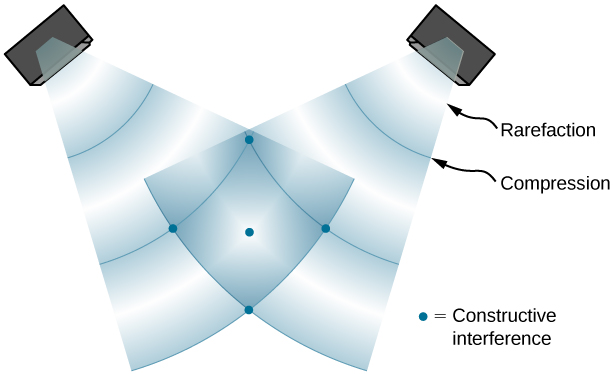
When the waves leave the speakers, they move out as spherical waves (Figure 17.4.1). The waves interfere; constructive inference is produced by the combination of two crests or two troughs, as shown. Destructive interference is produced by the combination of a trough and a crest.
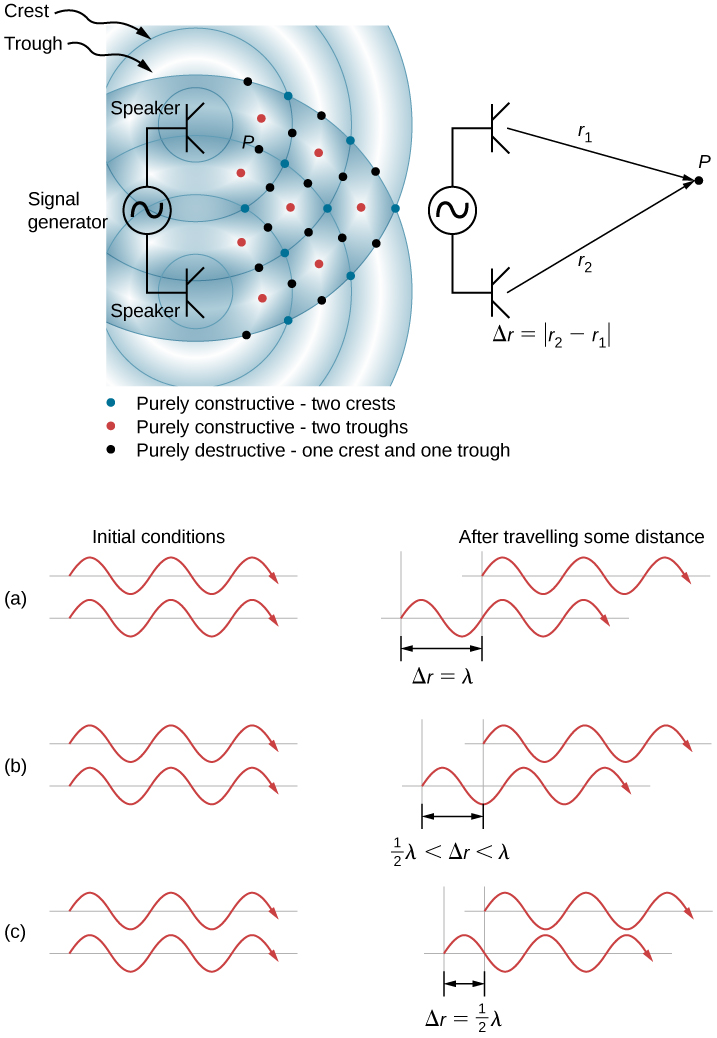 P. (a) The difference in the path lengths is one wavelength, resulting in total constructive interference and a resulting amplitude equal to twice the original amplitude. (b) The difference in the path lengths is less than one wavelength but greater than one half a wavelength, resulting in an amplitude greater than zero and less than twice the original amplitude. (c) The difference in the path lengths is one half of a wavelength, resulting in total destructive interference and a resulting amplitude of zero." loading="lazy"/>
The phase difference at each point is due to the different path lengths traveled by each wave. When the difference in the path lengths is an integer multiple of a wavelength,
\Delta r=|{r}_{2} - {r}_{1}|=n\lambda,\,\text{where}\,n=0,1,2,3\text{,}\ldots\text{,}the waves are in phase and there is constructive interference. When the difference in path lengths is an odd multiple of a half wavelength,
\Delta r=|{r}_{2} - {r}_{1}|=n\frac{\lambda}{2},\,\text{where}\,n=1,3,5\text{,}\ldots\text{,}the waves are US180^\circ(\pi\,\text{rad}) out of phase and the result is destructive interference. These points can be located with a sound-level intensity meter.
Q1. If you walk around two speakers playing music, how come you do not notice places where the music is very loud or very soft, that is, where there is constructive and destructive interference?
Answer: In the example, the two speakers were producing sound at a single frequency. Music has various frequencies and wavelengths.
The concept of a phase shift due to a difference in path length is very important. You will use this concept again in Interference and Photons and Matter Waves, where we discuss how Thomas Young used this method in his famous double-slit experiment to provide evidence that light has wavelike properties.
Noise Reduction through Destructive Interference
Register to read the full text
This page shows only part of the content. Register or log in to read it all.
Register / Log in