Sound Intensity in University Physics
In a quiet forest, you can sometimes hear a single leaf fall to the ground. But when a passing motorist has their stereo turned up, you cannot even hear what the person next to you in your car is saying (Figure 17.3.1). We are all very familiar with the loudness of sounds and are aware that loudness is related to how energetically the source is vibrating. High noise exposure is hazardous to hearing, which is why it is important for people working in industrial settings to wear ear protection. The relevant physical quantity is sound intensity, a concept that is valid for all sounds whether or not they are in the audible range.

In Waves, we defined intensity as the power per unit area carried by a wave. Power is the rate at which energy is transferred by the wave. In equation form, intensity I is
I=\frac{P}{A},where P is the power through an area A. The SI unit for I is {\text{W/m} }^{2}. If we assume that the sound wave is spherical, and that no energy is lost to thermal processes, the energy of the sound wave is spread over a larger area as distance increases, so the intensity decreases. The area of a sphere is A=4\pi{r}^{2}. As the wave spreads out from {r}_{1} to {r}_{2}, the energy also spreads out over a larger area:
\begin{aligned}{P}_{1} & = & {P}_{2} \\ {I}_{1}4\pi{r}_{1}^{2} & = & {I}_{2}4\pi{r}_{2}^{2};\end{aligned} {I}_{2}={I}_{1}{(\frac{ {r}_{1} }{ {r}_{2} })}^{2}.The intensity decreases as the wave moves out from the source. In an inverse square relationship, such as the intensity, when you double the distance, the intensity decreases to one quarter,
{I}_{2}={I}_{1}{(\frac{ {r}_{1} }{ {r}_{2} })}^{2}={I}_{1}{(\frac{ {r}_{1} }{2{r}_{1} })}^{2}=\frac{1}{4}{I}_{1}.Generally, when considering the intensity of a sound wave, we take the intensity to be the time-averaged value of the power, denoted by \langle P\rangle , divided by the area,
I=\frac{\langle P\rangle }{A}.The intensity of a sound wave is proportional to the change in the pressure squared and inversely proportional to the density and the speed. Consider a parcel of a medium initially undisturbed and then influenced by a sound wave at time t, as shown in Figure 17.3.2.
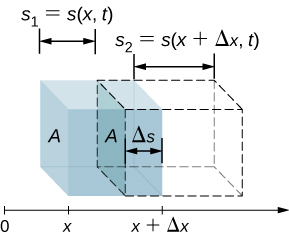 V=A\Delta x shown in blue. A sound wave moves through the medium at time t, and the parcel is displaced and expands, as shown by dotted lines. The change in volume is \Delta V=A\Delta s=A({s}_{2} - {s}_{1}), where {s}_{1} is the displacement of the leading edge of the parcel and {s}_{2} is the displacement of the trailing edge of the parcel. In the figure, {s}_{2}>{s}_{1} and the parcel expands, but the parcel can either expand or compress ({s}_{2}<{s}_{1}), depending on which part of the sound wave (compression or rarefaction) is moving through the parcel." loading="lazy"/>
As the sound wave moves through the parcel, the parcel is displaced and may expand or contract. If {s}_{2}>{s}_{1}, the volume has increased and the pressure decreases. If {s}_{2}<{s}_{1}, the volume has decreased and the pressure increases. The change in the volume is
\Delta V=A\Delta s=A({s}_{2} - {s}_{1})=A(s(x+\Delta x,t)-s(x,t)).The fractional change in the volume is the change in volume divided by the original volume:
\frac{dV}{V}=\underset{\Delta x\to0}{\text{lim} }\frac{A[s(x+\Delta x,t)-s(x,t)]}{A\Delta x}=\frac{\partial s(x,t)}{\partial x}.The fractional change in volume is related to the pressure fluctuation by the bulk modulus\beta=-\frac{\Delta p(x,t)}{dV\text{/}V}. Recall that the minus sign is required because the volume is inversely related to the pressure. (We use lowercase p for pressure to distinguish it from power, denoted by P.) The change in pressure is therefore \Delta p(x,t)=\text{-}\beta\frac{dV}{V}=\text{-}\beta\frac{\partial s(x,t)}{\partial x}. If the sound wave is sinusoidal, then the displacement as shown in is s(x,t)={s}_{\text{max} }\text{cos}(kx\mp\omega t+\phi) and the pressure is found to be
\Delta p(x,t)=\text{-}\beta\frac{dV}{V}=\text{-}\beta\frac{\partial s(x,t)}{\partial x}=\beta k{s}_{\text{max} }\text{sin}(kx-\omega t+\phi)=\Delta{p}_{\text{max} }\text{sin}(kx-\omega t+\phi).The intensity of the sound wave is the power per unit area, and the power is the force times the velocity, I=\frac{P}{A}=\frac{Fv}{A}=pv. Here, the velocity is the velocity of the oscillations of the medium, and not the velocity of the sound wave. The velocity of the medium is the time rate of change in the displacement:
v(x,t)=\frac{\partial}{\partial t}s(x,t)=\frac{\partial}{\partial t}({s}_{\text{max} }\text{cos}(kx-\omega t+\phi))={s}_{\text{max} }\omega\,\text{sin}(kx-\omega t+\phi).Thus, the intensity becomes
Register to read the full text
This page shows only part of the content. Register or log in to read it all.
Register / Log in