Speed of Sound in University Physics
Sound, like all waves, travels at a certain speed and has the properties of frequency and wavelength. You can observe direct evidence of the speed of sound while watching a fireworks display (Figure 17.2.1). You see the flash of an explosion well before you hear its sound and possibly feel the pressure wave, implying both that sound travels at a finite speed and that it is much slower than light.

The difference between the speed of light and the speed of sound can also be experienced during an electrical storm. The flash of lighting is often seen before the clap of thunder. You may have heard that if you count the number of seconds between the flash and the sound, you can estimate the distance to the source. Every five seconds converts to about one mile. The velocity of any wave is related to its frequency and wavelength by
v=f\lambda,where v is the speed of the wave, f is its frequency, and \lambda is its wavelength. Recall from Waves that the wavelength is the length of the wave as measured between sequential identical points. For example, for a surface water wave or sinusoidal wave on a string, the wavelength can be measured between any two convenient sequential points with the same height and slope, such as between two sequential crests or two sequential troughs. Similarly, the wavelength of a sound wave is the distance between sequential identical parts of a wave—for example, between sequential compressions (Figure 17.2.2). The frequency is the same as that of the source and is the number of waves that pass a point per unit time.
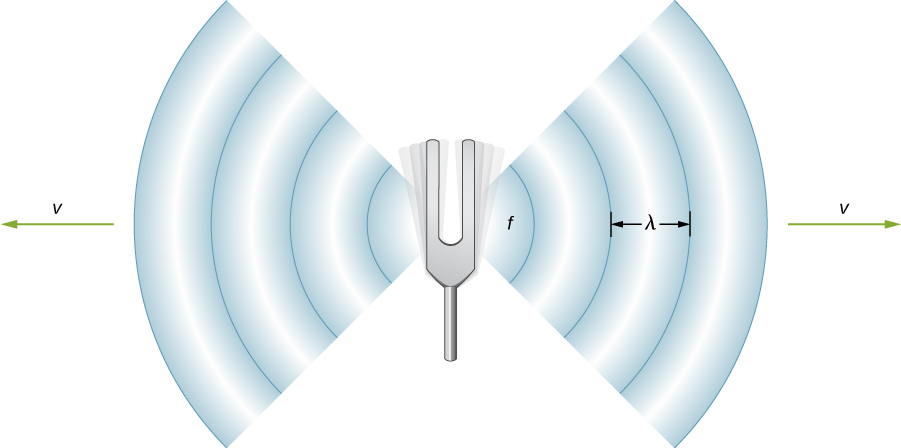 f. It propagates at speed v and has a wavelength \lambda." loading="lazy"/>
Speed of Sound in Various Media
Table 17.2.1 shows that the speed of sound varies greatly in different media. The speed of sound in a medium depends on how quickly vibrational energy can be transferred through the medium. For this reason, the derivation of the speed of sound in a medium depends on the medium and on the state of the medium. In general, the equation for the speed of a mechanical wave in a medium depends on the square root of the restoring force, or the elastic property, divided by the inertial property,
v=\sqrt{\frac{\text{elastic}\,\text{property} }{\text{inertial}\,\text{property} } }.Also, sound waves satisfy the wave equation derived in Waves,
\frac{ {\partial}^{2}y(x,t)}{\partial{x}^{2} }=\frac{1}{ {v}^{2} }\,\frac{ {\partial}^{2}y(x,t)}{\partial{t}^{2} }.Recall from Waves that the speed of a wave on a string is equal to v=\sqrt{\frac{ {F}_{T} }{\mu} }, where the restoring force is the tension in the string {F}_{T} and the linear density \mu is the inertial property. In a fluid, the speed of sound depends on the bulk modulus and the density,
v=\sqrt{\frac{B}{\rho} }.The speed of sound in a solid depends on the Young’s modulus of the medium and the density,
v=\sqrt{\frac{Y}{\rho} }.In an ideal gas (see The Kinetic Theory of Gases), the equation for the speed of sound is
v=\sqrt{\frac{\gamma R{T}_{\text{K} } }{M} },where \gamma is the adiabatic index, R=8.31\,\text{J/mol}\cdot\text{K} is the gas constant, {T}_{\text{K} } is the absolute temperature in kelvins, and M is the molar mass. In general, the more rigid (or less compressible) the medium, the faster the speed of sound. This observation is analogous to the fact that the frequency of simple harmonic motion is directly proportional to the stiffness of the oscillating object as measured by k, the spring constant. The greater the density of a medium, the slower the speed of sound. This observation is analogous to the fact that the frequency of a simple harmonic motion is inversely proportional to m, the mass of the oscillating object. The speed of sound in air is low, because air is easily compressible. Because liquids and solids are relatively rigid and very difficult to compress, the speed of sound in such media is generally greater than in gases.
Table 17.2.1 Speed of Sound in Various Media
Medium v (m/s)
Gases at US0^\circ C
Air;331
Carbon dioxide;259
Oxygen;316
Helium;965
Hydrogen;1290
Liquids at US20^\circ C
Ethanol;1160
Mercury;1450
Water, fresh;1480
Sea Water;1540
Human tissue;1540
Solids (longitudinal or bulk)
Vulcanized rubber;54
Polyethylene;920
Marble;3810
Glass, Pyrex;5640
Lead;1960
Aluminum;5120
Steel;5960
Because the speed of sound depends on the density of the material, and the density depends on the temperature, there is a relationship between the temperature in a given medium and the speed of sound in the medium. For air at sea level, the speed of sound is given by
Register to read the full text
This page shows only part of the content. Register or log in to read it all.
Register / Log in