Potential Energy of a System
In Work, we saw that the work done on an object by the constant gravitational force, near the surface of Earth, over any displacement is a function only of the difference in the positions of the end-points of the displacement. This property allows us to define a different kind of energy for the system than its kinetic energy, which is called potential energy. We consider various properties and types of potential energy in the following subsections.
Potential Energy Basics
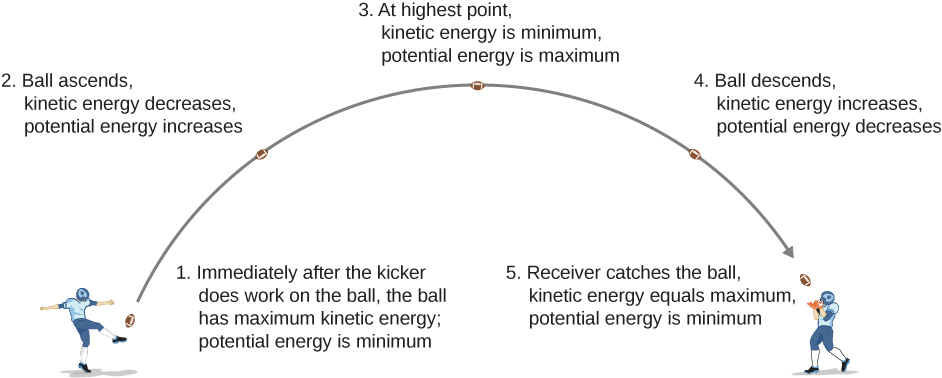
In Motion in Two and Three Dimensions, we analyzed the motion of a projectile, like kicking a football in Figure 8.1.1. For this example, let’s ignore friction and air resistance and begin the analysis immediately after the kick, at the start of the projectile motion of the ball. As the football rises, the work done by the gravitational force on the football is negative, because the ball’s displacement is positive vertically and the force due to gravity is negative vertically. We also noted that the ball slowed down until it reached its highest point in the motion, thereby decreasing the ball’s kinetic energy. This loss in kinetic energy translates to a gain in gravitational potential energy of the football-Earth system.
As the football falls toward Earth, the work done on the football is now positive, because the displacement and the gravitational force both point vertically downward. The ball also speeds up, which indicates an increase in kinetic energy. Therefore, energy is converted from gravitational potential energy back into kinetic energy.
Based on this scenario, we can define the difference of potential energy from point A to point B as the negative of the work done:
\Delta{U}_{AB}={U}_{B} - {U}_{A}=\text{-}{W}_{AB}.This formula explicitly states a potential energy difference, not just an absolute potential energy. Therefore, we need to define potential energy at a given position in such a way as to state standard values of potential energy on their own, rather than potential energy differences. We do this by rewriting the potential energy function in terms of an arbitrary constant,
\Delta U=U(\mathbf{\vec{r} })-U({\mathbf{\vec{r} } }_{0}).The choice of the potential energy at a starting location of {\mathbf{\vec{r} } }_{0} is made out of convenience in the given problem. Most importantly, whatever choice is made should be stated and kept consistent throughout the given problem. There are some well-accepted choices of initial potential energy. For example, the lowest height in a problem is usually defined as zero potential energy, or if an object is in space, the farthest point away from the system is often defined as zero potential energy. Then, the potential energy, with respect to zero at {\mathbf{\vec{r} } }_{0}, is just U(\vec{r}).
As long as there is no friction or air resistance, the change in kinetic energy of the football equals negative of the change in gravitational potential energy of the football. This can be generalized to any potential energy:
\Delta{K}_{AB}=\,-\Delta{U}_{AB}.Let’s look at a specific example, choosing zero potential energy for gravitational potential energy at convenient points.
Q1. In, what are the potential energies of the particle at x=1\,\text{m} and x=2\,\text{m} with respect to zero at x=1.5\,\text{m}? Verify that the difference of potential energy is still 7 J.
Answer: (4.63\,\text{J})-(-2.38\,\text{J})=7.00\,\text{J}
Systems of Several Particles
In general, a system of interest could consist of several particles. The difference in the potential energy of the system is the negative of the work done by gravitational or elastic forces, which, as we will see in the next section, are conservative forces. The potential energy difference depends only on the initial and final positions of the particles, and on some parameters that characterize the interaction (like mass for gravity or the spring constant for a Hooke’s law force).
It is important to remember that potential energy is a property of the interactions between objects in a chosen system, and not just a property of each object. This is especially true for electric forces, although in the examples of potential energy we consider below, parts of the system are either so big (like Earth, compared to an object on its surface) or so small (like a massless spring), that the changes those parts undergo are negligible when included in the system.
Types of Potential Energy
Register to read the full text
This page shows only part of the content. Register or log in to read it all.
Register / Log in