Work in University Physics
In physics, work is done on an object when energy is transferred to the object. In other words, work is done when a force acts on something that undergoes a displacement from one position to another. Forces can vary as a function of position, and displacements can be along various paths between two points. We first define the increment of work dW done by a force \vec{\vec{F} } acting through an infinitesimal displacement d\mathbf{\vec{r} } as the dot product of these two vectors:
dW=\vec{\vec{F} }\cdot d\mathbf{\vec{r} }=|\vec{\vec{F} }||d\mathbf{\vec{r} }|\text{cos}\,\theta.Then, we can add up the contributions for infinitesimal displacements, along a path between two positions, to get the total work.
Work Done by a Force
The work done by a force is the integral of the force with respect to displacement along the path of the displacement:
{W}_{AB}=\underset{\text{path}\,AB}{\int}\mathbf{\vec{F} }\cdot d\mathbf{\vec{r} }.The vectors involved in the definition of the work done by a force acting on a particle are illustrated in Figure 7.1.1. While in general, requires mathematics beyond the scope of this text, in many simple situations this integral becomes a familiar integral in one variable. We will examine several such examples and restrict our discussion to these cases.
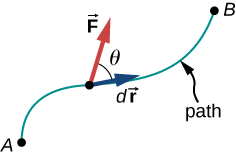 A and B. The infinitesimal work is the dot product of these two vectors; the total work is the integral of the dot product along the path." loading="lazy"/>
We choose to express the dot product in terms of the magnitudes of the vectors and the cosine of the angle between them, because the meaning of the dot product for work can be put into words more directly in terms of magnitudes and angles. We could equally well have expressed the dot product in terms of the various components introduced in Vectors. In two dimensions, these were the x- and y-components in Cartesian coordinates, or the r- and \varphi-components in polar coordinates; in three dimensions, it was just x-, y-, and z-components. Which choice is more convenient depends on the situation. In words, you can express for the work done by a force acting over a displacement as a product of one component acting parallel to the other component. From the properties of vectors, it doesn’t matter if you take the component of the force parallel to the displacement or the component of the displacement parallel to the force—you get the same result either way.
Recall that the magnitude of a force times the cosine of the angle the force makes with a given direction is the component of the force in the given direction. The components of a vector can be positive, negative, or zero, depending on whether the angle between the vector and the component-direction is between US0^\circ and US90^\circ or US90^\circ and US180^\circ, or is equal to US90^\circ. As a result, the work done by a force can be positive, negative, or zero, depending on whether the force is generally in the direction of the displacement, generally opposite to the displacement, or perpendicular to the displacement. The maximum work is done by a given force when it is along the direction of the displacement (\text{cos}\,\theta=\pm1), and zero work is done when the force is perpendicular to the displacement (\text{cos}\,\theta=0).
The units of work are units of force multiplied by units of length, which in the SI system is newtons times meters, \text{N}\cdot\text{m.} This combination is called a joule, for historical reasons that we will mention later, and is abbreviated as J. In the English system, still used in the United States, the unit of force is the pound (lb) and the unit of distance is the foot (ft), so the unit of work is the foot-pound (\text{ft}\cdot\text{lb})\text{.}
Work Done by Constant Forces and Contact Forces
The simplest work to evaluate is that done by a force that is constant in magnitude and direction. In this case, we can factor out the force; the remaining integral is just the total displacement, which only depends on the end points A and B, but not on the path between them:
{W}_{AB}=\vec{\vec{F} }\cdot{\int}_{A}^{B}d\mathbf{\vec{r} }=\vec{\vec{F} }\cdot({\mathbf{\vec{r} } }_{B} - {\mathbf{\vec{r} } }_{A})=|\vec{\vec{F} }||{\mathbf{\vec{r} } }_{B} - {\mathbf{\vec{r} } }_{A}|\text{cos}\,\theta\quad\text{(constant force).}Figure 7.1.2(a) shows a person exerting a constant force \vec{\vec{F} } along the handle of a lawn mower, which makes an angle \theta with the horizontal. The horizontal displacement of the lawn mower, over which the force acts, is \vec{\vec{d} }. The work done on the lawn mower isW=\vec{\vec{F} }\cdot\vec{\vec{d} }=Fd\,\text{cos}\,\theta, which the figure also illustrates as the horizontal component of the force times the magnitude of the displacement.
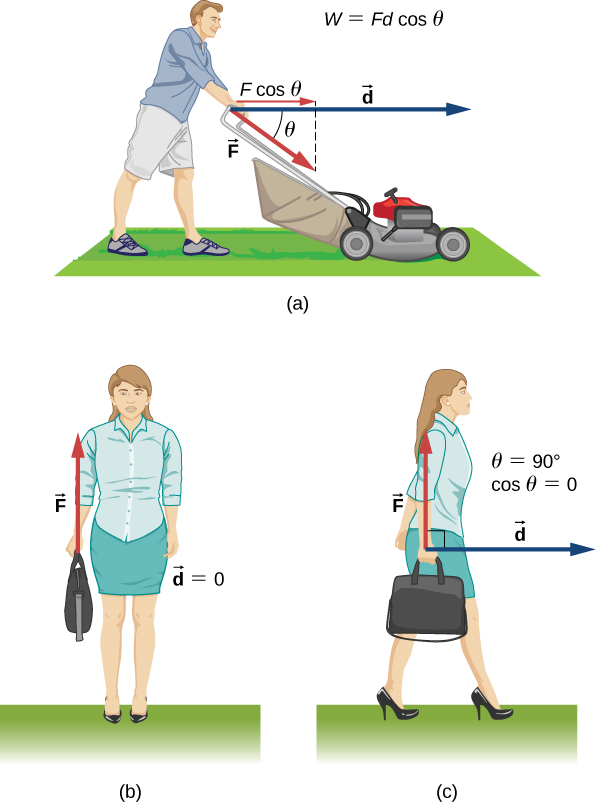 \text{cos}\,\theta is zero." loading="lazy"/>
Figure 7.1.2(b) shows a person holding a briefcase. The person must exert an upward force, equal in magnitude to the weight of the briefcase, but this force does no work, because the displacement over which it acts is zero.
In Figure 7.1.2(c), where the person in (b) is walking horizontally with constant speed, the work done by the person on the briefcase is still zero, but now because the angle between the force exerted and the displacement is US90^\circ (\vec{\vec{F} } perpendicular to \vec{\vec{d} }) and \text{cos}\,90^\circ=0.
Register to read the full text
This page shows only part of the content. Register or log in to read it all.
Register / Log in