Drag Force and Terminal Speed
Another interesting force in everyday life is the force of drag on an object when it is moving in a fluid (either a gas or a liquid). You feel the drag force when you move your hand through water. You might also feel it if you move your hand during a strong wind. The faster you move your hand, the harder it is to move. You feel a smaller drag force when you tilt your hand so only the side goes through the air—you have decreased the area of your hand that faces the direction of motion.
Drag Forces
Like friction, the drag force always opposes the motion of an object. Unlike simple friction, the drag force is proportional to some function of the velocity of the object in that fluid. This functionality is complicated and depends upon the shape of the object, its size, its velocity, and the fluid it is in. For most large objects such as cyclists, cars, and baseballs not moving too slowly, the magnitude of the drag force {F}_{\text{D} } is proportional to the square of the speed of the object. We can write this relationship mathematically as {F}_{\text{D} }\propto{v}^{2}. When taking into account other factors, this relationship becomes
{F}_{\text{D} }=\frac{1}{2}C\rho A{v}^{2},where C is the drag coefficient, A is the area of the object facing the fluid, and \rho is the density of the fluid. (Recall that density is mass per unit volume.) This equation can also be written in a more generalized fashion as {F}_{\text{D} }=b{v}^{n}, where b is a constant equivalent to US0.5C\rho A. We have set the exponent n for these equations as 2 because when an object is moving at high velocity through air, the magnitude of the drag force is proportional to the square of the speed. As we shall see in Fluid Mechanics, for small particles moving at low speeds in a fluid, the exponent n is equal to 1.
Drag Force
Drag force {F}_{\text{D} } is proportional to the square of the speed of the object. Mathematically,
{F}_{\text{D} }=\frac{1}{2}C\,\rho\,A{v}^{2},where C is the drag coefficient, A is the area of the object facing the fluid, and \rho is the density of the fluid.
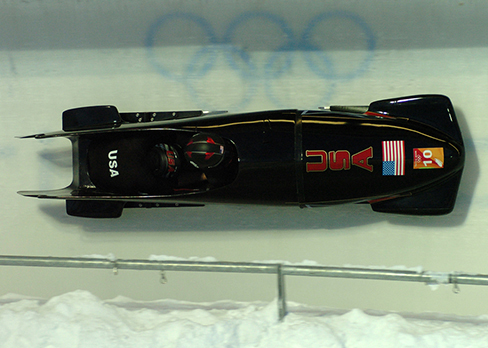
Athletes as well as car designers seek to reduce the drag force to lower their race times (Figure 6.4.1). Aerodynamic shaping of an automobile can reduce the drag force and thus increase a car’s gas mileage.
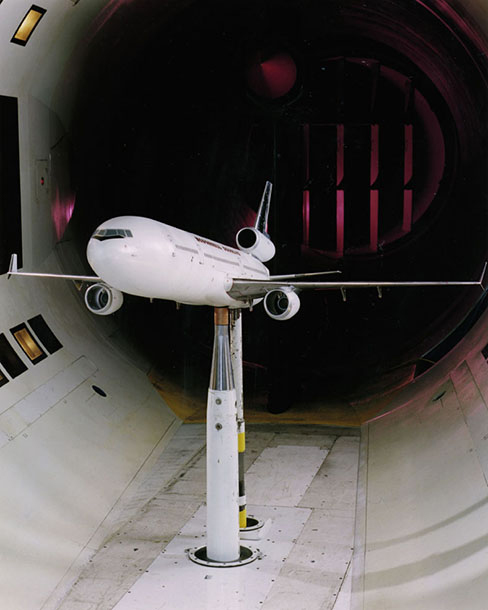
The value of the drag coefficient C is determined empirically, usually with the use of a wind tunnel (Figure 6.4.2).
The drag coefficient can depend upon velocity, but we assume that it is a constant here. Table 6.4.1 lists some typical drag coefficients for a variety of objects. Notice that the drag coefficient is a dimensionless quantity. At highway speeds, over US50\% of the power of a car is used to overcome air drag. The most fuel-efficient cruising speed is about 70–80 km/h (about 45–50 mi/h). For this reason, during the 1970s oil crisis in the United States, maximum speeds on highways were set at about 90 km/h (55 mi/h).
Table 6.4.1 Typical Values of Drag Coefficient C
Object C
Airfoil;0.05
Toyota Camry;0.28
Ford Focus;0.32
Honda Civic;0.36
Ferrari Testarossa;0.37
Dodge Ram Pickup;0.43
Sphere;0.45
Hummer H2 SUV;0.64
Skydiver (feet first);0.70
Bicycle;0.90
Skydiver (horizontal);1.0
Circular flat plate;1.12
Substantial research is under way in the sporting world to minimize drag. The dimples on golf balls are being redesigned, as are the clothes that athletes wear. Bicycle racers and some swimmers and runners wear full bodysuits. Australian Cathy Freeman wore a full body suit in the 2000 Sydney Olympics and won a gold medal in the 400-m race. Many swimmers in the 2008 Beijing Olympics wore (Speedo) body suits; it might have made a difference in breaking many world records (Figure 6.4.3). Most elite swimmers (and cyclists) shave their body hair. Such innovations can have the effect of slicing away milliseconds in a race, sometimes making the difference between a gold and a silver medal. One consequence is that careful and precise guidelines must be continuously developed to maintain the integrity of the sport.
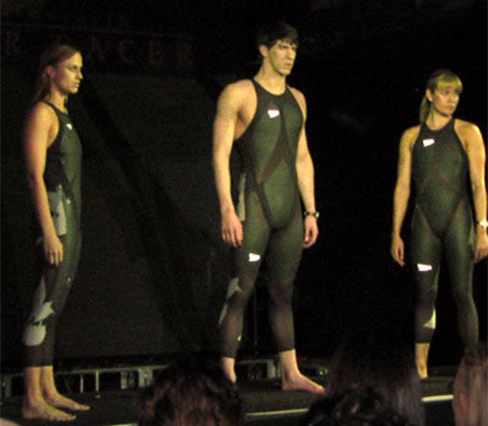 10\% less drag. (credit: NASA/Kathy Barnstorff)" loading="lazy"/>
Terminal Velocity
Some interesting situations connected to Newton’s second law occur when considering the effects of drag forces upon a moving object. For instance, consider a skydiver falling through air under the influence of gravity. The two forces acting on him are the force of gravity and the drag force (ignoring the small buoyant force). The downward force of gravity remains constant regardless of the velocity at which the person is moving. However, as the person’s velocity increases, the magnitude of the drag force increases until the magnitude of the drag force is equal to the gravitational force, thus producing a net force of zero. A zero net force means that there is no acceleration, as shown by Newton’s second law. At this point, the person’s velocity remains constant and we say that the person has reached his terminal velocity ({v}_{\text{T} }). Since {F}_{\text{D} } is proportional to the speed squared, a heavier skydiver must go faster for {F}_{\text{D} } to equal his weight. Let’s see how this works out more quantitatively.
At the terminal velocity,
{F}_{\text{net} }=mg- {F}_{\text{D} }=ma=0.Thus,
mg={F}_{\text{D} }.Using the equation for drag force, we have
mg=\frac{1}{2}C\rho A{v}_{\text{T} }^{2}.Solving for the velocity, we obtain
{v}_{\text{T} }=\sqrt{\frac{2mg}{\rho CA} }.Assume the density of air is \rho=1.21\,{\text{kg/m} }^{3}. A 75-kg skydiver descending head first has a cross-sectional area of approximately A=0.18\,{\text{m} }^{2} and a drag coefficient of approximately C=0.70. We find that
{v}_{\text{T} }=\sqrt{\frac{2(75\,\text{kg})(9.80\,{\text{m/s} }^{2})}{(1.21\,{\text{kg/m} }^{3})(0.70)(0.18\,{\text{m} }^{2})} }=98\,\text{m/s}=350\,\text{km/h}\text{.}This means a skydiver with a mass of 75 kg achieves a terminal velocity of about 350 km/h while traveling in a headfirst position, minimizing the area and his drag. In a spread-eagle position, that terminal velocity may decrease to about 200 km/h as the area increases. This terminal velocity becomes much smaller after the parachute opens.
Q1. Find the terminal velocity of a 50-kg skydiver falling in spread-eagle fashion.
Answer: 34 m/s
The size of the object that is falling through air presents another interesting application of air drag. If you fall from a 5-m-high branch of a tree, you will likely get hurt—possibly fracturing a bone. However, a small squirrel does this all the time, without getting hurt. You do not reach a terminal velocity in such a short distance, but the squirrel does.
The following interesting quote on animal size and terminal velocity is from a 1928 essay by a British biologist, J. B. S. Haldane, titled “On Being the Right Size.”
“To the mouse and any smaller animal, [gravity] presents practically no dangers. You can drop a mouse down a thousand-yard mine shaft; and, on arriving at the bottom, it gets a slight shock and walks away, provided that the ground is fairly soft. A rat is killed, a man is broken, and a horse splashes. For the resistance presented to movement by the air is proportional to the surface of the moving object. Divide an animal’s length, breadth, and height each by ten; its weight is reduced to a thousandth, but its surface only to a hundredth. So the resistance to falling in the case of the small animal is relatively ten times greater than the driving force.”
The above quadratic dependence of air drag upon velocity does not hold if the object is very small, is going very slow, or is in a denser medium than air. Then we find that the drag force is proportional just to the velocity. This relationship is given by Stokes’ law.
Stokes’ Law
For a spherical object falling in a medium, the drag force is
{F}_{\text{s} }=6\pi r\eta v,where r is the radius of the object, \eta is the viscosity of the fluid, and v is the object’s velocity.
Good examples of Stokes’ law are provided by microorganisms, pollen, and dust particles. Because each of these objects is so small, we find that many of these objects travel unaided only at a constant (terminal) velocity. Terminal velocities for bacteria (size about 1\,\mu\text{m}) can be about 2\,\mu\text{m/s}\text{.} To move at a greater speed, many bacteria swim using flagella (organelles shaped like little tails) that are powered by little motors embedded in the cell.
Register to read the full text
This page shows only part of the content. Register or log in to read it all.
Register / Log in