Centripetal Force in University Physics
In Motion in Two and Three Dimensions, we examined the basic concepts of circular motion. An object undergoing circular motion, like one of the race cars shown at the beginning of this chapter, must be accelerating because it is changing the direction of its velocity. We proved that this centrally directed acceleration, called centripetal acceleration, is given by the formula
{a}_{\text{c} }=\frac{ {v}^{2} }{r}where v is the velocity of the object, directed along a tangent line to the curve at any instant. If we know the angular velocity \omega, then we can use
{a}_{\text{c} }=r{\omega}^{2}.Angular velocity gives the rate at which the object is turning through the curve, in units of rad/s. This acceleration acts along the radius of the curved path and is thus also referred to as a radial acceleration.
An acceleration must be produced by a force. Any force or combination of forces can cause a centripetal or radial acceleration. Just a few examples are the tension in the rope on a tether ball, the force of Earth’s gravity on the Moon, friction between roller skates and a rink floor, a banked roadway’s force on a car, and forces on the tube of a spinning centrifuge. Any net force causing uniform circular motion is called a centripetal force. The direction of a centripetal force is toward the center of curvature, the same as the direction of centripetal acceleration. According to Newton’s second law of motion, net force is mass times acceleration: {F}_{\text{net} }=ma. For uniform circular motion, the acceleration is the centripetal acceleration:.a={a}_{\text{c} }. Thus, the magnitude of centripetal force {F}_{\text{c} } is
{F}_{\text{c} }=m{a}_{\text{c} }.By substituting the expressions for centripetal acceleration {a}_{\text{c} } ({a}_{\text{c} }=\frac{ {v}^{2} }{r};{a}_{\text{c} }=r{\omega}^{2}), we get two expressions for the centripetal force {F}_{\text{c} } in terms of mass, velocity, angular velocity, and radius of curvature:
{F}_{\text{c} }=m\frac{ {v}^{2} }{r};\quad{F}_{\text{c} }=mr{\omega}^{2}.You may use whichever expression for centripetal force is more convenient. Centripetal force {\mathbf{\vec{F} } }_{\text{c} }is always perpendicular to the path and points to the center of curvature, because {\mathbf{\vec{a} } }_{\text{c} } is perpendicular to the velocity and points to the center of curvature. Note that if you solve the first expression for r, you get
r=\frac{m{v}^{2} }{ {F}_{\text{c} } }.This implies that for a given mass and velocity, a large centripetal force causes a small radius of curvature—that is, a tight curve, as in Figure 6.3.1.
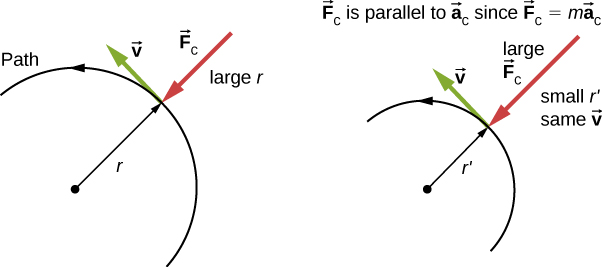 {F}_{\text{c} }, the smaller the radius of curvature r and the sharper the curve. The second curve has the same v, but a larger {F}_{\text{c} } produces a smaller r'." loading="lazy"/>
Q1. A car moving at 96.8 km/h travels around a circular curve of radius 182.9 m on a flat country road. What must be the minimum coefficient of static friction to keep the car from slipping?
Answer: 0.40
Banked Curves
Let us now consider banked curves, where the slope of the road helps you negotiate the curve (Figure 6.3.2). The greater the angle \theta, the faster you can take the curve. Race tracks for bikes as well as cars, for example, often have steeply banked curves. In an “ideally banked curve,” the angle \theta is such that you can negotiate the curve at a certain speed without the aid of friction between the tires and the road. We will derive an expression for \theta for an ideally banked curve and consider an example related to it.
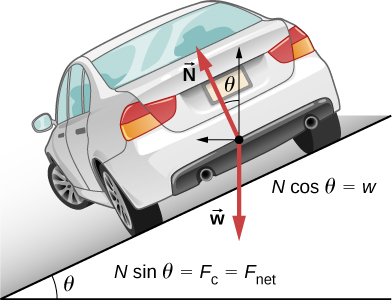
For ideal banking, the net external force equals the horizontal centripetal force in the absence of friction. The components of the normal force N in the horizontal and vertical directions must equal the centripetal force and the weight of the car, respectively. In cases in which forces are not parallel, it is most convenient to consider components along perpendicular axes—in this case, the vertical and horizontal directions.
Figure 6.3.2 shows a free-body diagram for a car on a frictionless banked curve. If the angle \theta is ideal for the speed and radius, then the net external force equals the necessary centripetal force. The only two external forces acting on the car are its weight \mathbf{\vec{w} } and the normal force of the road \mathbf{\vec{N} }. (A frictionless surface can only exert a force perpendicular to the surface—that is, a normal force.) These two forces must add to give a net external force that is horizontal toward the center of curvature and has magnitude m{v}^{2}\text{/}r. Because this is the crucial force and it is horizontal, we use a coordinate system with vertical and horizontal axes. Only the normal force has a horizontal component, so this must equal the centripetal force, that is,
N\,\text{sin}\,\theta=\frac{m{v}^{2} }{r}.Because the car does not leave the surface of the road, the net vertical force must be zero, meaning that the vertical components of the two external forces must be equal in magnitude and opposite in direction. From Figure 6.3.2, we see that the vertical component of the normal force is N\,\text{cos}\,\theta, and the only other vertical force is the car’s weight. These must be equal in magnitude; thus,
N\,\text{cos}\,\theta=mg.Now we can combine these two equations to eliminate N and get an expression for \theta, as desired. Solving the second equation for N=mg\text{/}(cos\theta) and substituting this into the first yields
\begin{aligned}mg\frac{\text{sin}\,\theta}{\text{cos}\,\theta} & = & \frac{m{v}^{2} }{r} \\ mg\,\text{tan}\,\theta & = & \frac{m{v}^{2} }{r} \\ \text{tan}\,\theta & = & \frac{ {v}^{2} }{rg}.\end{aligned}Taking the inverse tangent gives
\theta={\text{tan} }^{-1}(\frac{ {v}^{2} }{rg}).This expression can be understood by considering how \theta depends on v and r. A large \theta is obtained for a large v and a small r. That is, roads must be steeply banked for high speeds and sharp curves. Friction helps, because it allows you to take the curve at greater or lower speed than if the curve were frictionless. Note that \theta does not depend on the mass of the vehicle.
Airplanes also make turns by banking. The lift force, due to the force of the air on the wing, acts at right angles to the wing. When the airplane banks, the pilot is obtaining greater lift than necessary for level flight. The vertical component of lift balances the airplane’s weight, and the horizontal component accelerates the plane. The banking angle shown in Figure 6.3.3 is given by \theta. We analyze the forces in the same way we treat the case of the car rounding a banked curve.
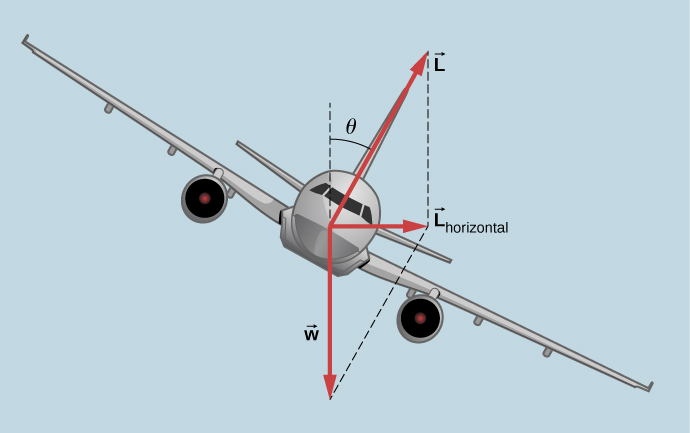 \theta. Compare the vector diagram with that shown in Figure 6.3.2." loading="lazy"/>
Register to read the full text
This page shows only part of the content. Register or log in to read it all.
Register / Log in