Nonconservative Forces
Learning Objectives
By the end of this section, you will be able to:
- Define nonconservative forces and explain how they affect mechanical energy.
- Show how the principle of conservation of energy can be applied by treating the conservative forces in terms of their potential energies and any nonconservative forces in terms of the work they do.
Nonconservative Forces and Friction
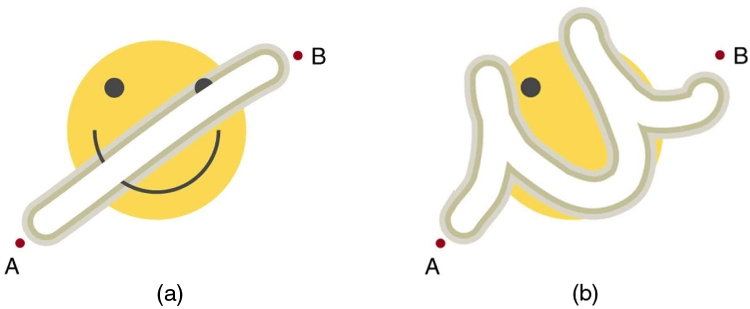
Forces are either conservative or nonconservative. Conservative forces were discussed in Conservative Forces and Potential Energy. A nonconservative force is one for which work depends on the path taken. Friction is a good example of a nonconservative force. As illustrated in Figure 7.5.1, work done against friction depends on the length of the path between the starting and ending points. Because of this dependence on path, there is no potential energy associated with nonconservative forces. An important characteristic is that the work done by a nonconservative force adds or removes mechanical energy from a system. Friction, for example, creates thermal energy that dissipates, removing energy from the system. Furthermore, even if the thermal energy is retained or captured, it cannot be fully converted back to work, so it is lost or not recoverable in that sense as well.
How Nonconservative Forces Affect Mechanical Energy
Mechanical energy may not be conserved when nonconservative forces act. For example, when a car is brought to a stop by friction on level ground, it loses kinetic energy, which is dissipated as thermal energy, reducing its mechanical energy. Figure 7.5.2 compares the effects of conservative and nonconservative forces. We often choose to understand simpler systems such as that described in Figure 7.5.2(a) first before studying more complicated systems as in Figure 7.5.2(b).
Register to read the full text
This page shows only part of the content. Register or log in to read it all.
Register / Log in