Rotation Angle and Angular Velocity
Learning Objectives
By the end of this section, you will be able to:
- Define arc length, rotation angle, radius of curvature and angular velocity.
- Calculate the angular velocity of a car wheel spin.
In Kinematics, we studied motion along a straight line and introduced such concepts as displacement, velocity, and acceleration. Two-Dimensional Kinematics dealt with motion in two dimensions. Projectile motion is a special case of two-dimensional kinematics in which the object is projected into the air, while being subject to the gravitational force, and lands a distance away. In this chapter, we consider situations where the object does not land but moves in a curve. We begin the study of uniform circular motion by defining two angular quantities needed to describe rotational motion.
Rotation Angle
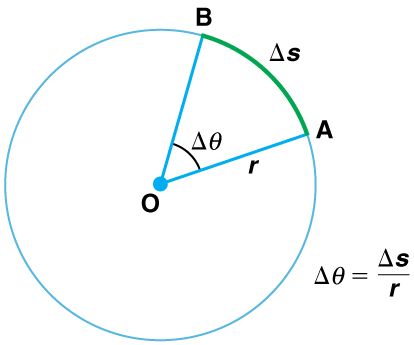
When objects rotate about some axis—for example, when the CD (compact disc) in rotates about its center—each point in the object follows a circular arc. Consider a line from the center of the CD to its edge. Each pit used to record sound along this line moves through the same angle in the same amount of time. The rotation angle is the amount of rotation and is analogous to linear distance. We define the rotation angle \Delta\theta to be the ratio of the arc length to the radius of curvature:
\Delta\theta=\frac{\Delta s}{r}\text{.}All points on a CD travel in circular arcs. The pits along a line from the center to the edge all move through the same angle \Delta\theta in a time \Delta t.
 \Delta\theta. The arc length \Delta\text{s} is described on the circumference." loading="lazy"/>
The arc length\:\Delta s is the distance traveled along a circular path as shown in Figure 6.1.1 Note that r is the radius of curvature of the circular path.
We know that for one complete revolution, the arc length is the circumference of a circle of radius r. The circumference of a circle is 2\pi r. Thus for one complete revolution the rotation angle is
\Delta\theta=\frac{2\pi r}{r}=2\pi\text{.}This result is the basis for defining the units used to measure rotation angles, \Delta\theta to be radians (rad), defined so that
2\pi\:\text{rad }=\text{ 1 revolution.}A comparison of some useful angles expressed in both degrees and radians is shown in Table 6.1.1.
Table 6.1.1 Comparison of Angular Units
Degree Measures Radian Measure
\text{30}^\circ;\frac{\pi}{6} \text{60}^\circ;\frac{\pi}{3} \text{90}^\circ;\frac{\pi}{2} \text{120}^\circ;\frac{2\pi}{3} \text{135}^\circ;\frac{3\pi}{4} \text{180}^\circ;\piRegister to read the full text
This page shows only part of the content. Register or log in to read it all.
Register / Log in